ADORN
Typography & Printing
Charlotte Isabella Newman: A Pioneer of Victorian Jewellery Design
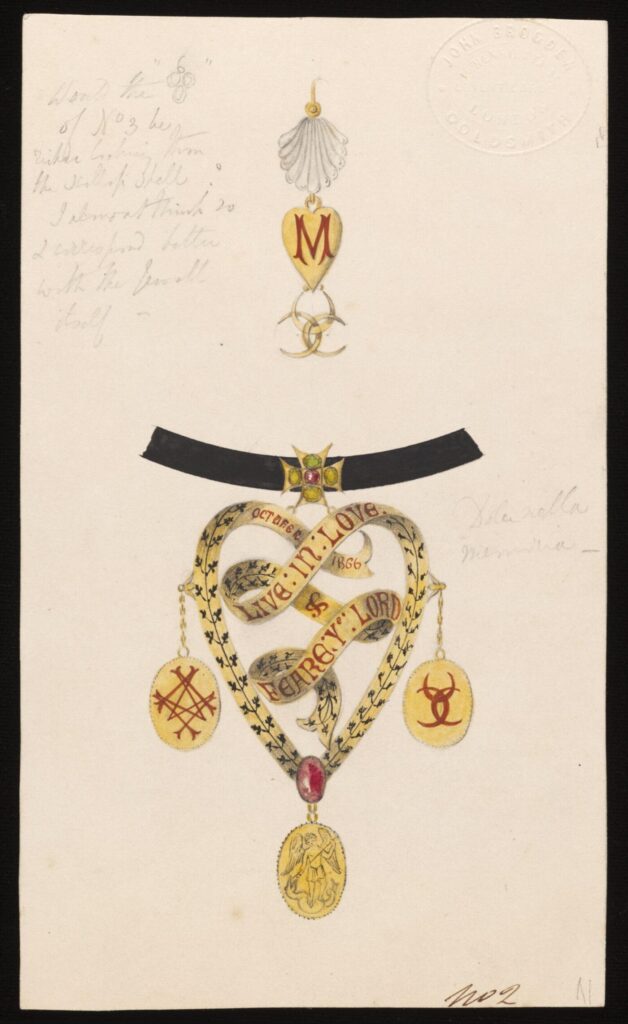
In the glittering world of 19th-century jewellery, few names shine as brightly—and as unexpectedly—as Charlotte Isabella Newman. Known professionally as Mrs. Philip Newman, she was a trailblazer in a field dominated by men, and her work helped shape the aesthetic of Victorian jewellery through a unique blend of historical inspiration and artistic innovation.
Charlotte Isabella Newman holds the distinction of being the first significant female studio jeweller to run a workshop under her own name in London. At a time when women were rarely seen in leadership roles within the decorative arts, Newman carved out a space for herself through sheer talent and determination. Her journey began at the Government School of Design at Somerset House and continued at South Kensington, where she was mentored by Sir Henry Cole, the founder of the Victoria and Albert Museum. Cole recognized her potential and encouraged her to explore a wide range of decorative arts, including textiles, ceramics, and carpets.
Charlotte Newman’s
Language of Ornament
My dearest readers,
Let us linger for a moment in the quiet brilliance of Charlotte Isabella Newman—a designer whose work with John Brogden’s firm in the mid-1860s helped shape the visual language of Victorian jewellery. At a time when the decorative arts were flourishing, Newman brought not only technical skill but a distinct sensibility that resonated with Brogden’s refined clientele. Her designs were singular, often bespoke, and rarely repeated—a testament to her belief that beauty should be personal, not prescribed.
One such design survives in the Brogden Album, a remarkable collection of over 1,500 drawings spanning nearly four decades. Among them is a necklace and earring set rendered in pencil, ink, watercolour, and body colour. Scallop shells, heart-shaped pendants, and monograms mingle with a gold cross set with emeralds and a central ruby. Beneath it, a scroll-inscribed heart band anchors three pendants, one depicting Archangel St. Michael. It is a composition rich in symbolism, suggesting Newman’s gift for storytelling through form and material.
Echoes of Antiquity
Newman’s work was deeply informed by the archaeological discoveries of her time. Excavations in Egypt, Rome, and Etruria sparked a wave of historical revivalism, and Newman responded with designs that nodded to ancient motifs while remaining distinctly Victorian. Her jewellery carried the weight of history—stylized references to classical forms reimagined for a modern audience. This was not imitation, but interpretation. Her pieces invited contemplation, offering layers of meaning beneath their surface beauty.
Recognition Abroad
Her talents were not confined to London’s drawing rooms. Newman and Brogden exhibited at the Paris Expositions of 1867 and 1878, where their work received international acclaim. In 1878, Newman was awarded the Médaille d’Honneur as a collaboratrice—a rare honour for a woman in the decorative arts. Brogden received the Croix de la Légion d’Honneur, but it was Newman’s hand that shaped many of the firm’s most poetic designs. Their partnership was one of mutual respect and creative daring.
A Lasting Influence
Charlotte Isabella Newman was more than a designer. She was a businesswoman, a pioneer, and a quiet force in an industry that rarely credited women. Her legacy endures not only in the archives of the Victoria and Albert Museum, but in the continued relevance of her approach—thoughtful, symbolic, and exquisitely executed. Today, her work inspires those who seek to blend historical depth with contemporary elegance.
In a world where jewellery often serves as a reflection of identity and heritage, Newman’s creations remind us that design can be both expressive and enduring. Her pieces were not simply decorative—they were crafted with intention, shaped by intellect, and imbued with quiet power.
Yours in observation and adornment,
Lady Westmacott
Leave a Reply