ADORN
Ornaments & Objects
Elegance in Utility: A Victorian Fish Serving Fork by George W. Adams
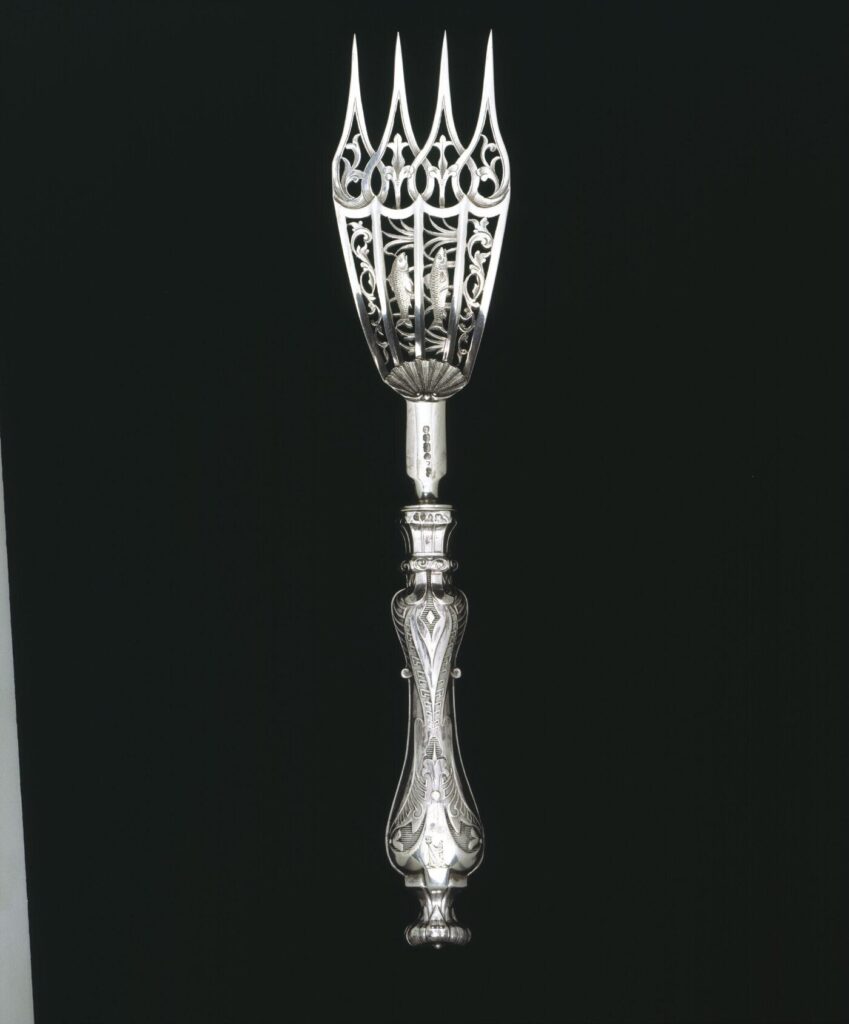
Victorian dining, where etiquette was elevated to ritual and every gesture carried social weight, even the humble fork was transformed into a work of art. Among the most exquisite examples of this transformation is the fish serving fork crafted by George W. Adams for Chawner & Co., hallmarked in 1850. This object, though utilitarian in purpose, embodies the Victorian ethos: beauty, symbolism, and craftsmanship woven into the fabric of everyday life.
The Silver Fish Fork:
A Utensil Worthy of Courtship
My dearest readers,
It has come to my attention that a certain silver fork—yes, a fork, though not of the ordinary sort—has been causing quite the stir amongst those with a taste for refinement and a penchant for historical intrigue. Allow me to lift the veil on this gleaming relic of Victorian domesticity, a utensil so elegant it might well have dined with Her Majesty herself.
A Fork Fit for Society’s Finest
In an age when steam and soot transformed fortunes overnight, the drawing rooms and dining tables of London’s upper crust underwent a metamorphosis most divine. No longer content with mere sustenance, the well-heeled classes turned their attention to the art of dining—where etiquette reigned supreme and every course demanded its own silvered companion. Enter the fish server: a utensil not merely for slicing trout, but for doing so with the grace of a duchess and the precision of a surgeon.
By the mid-1800s, boxed sets of fish carvers became the darling of bridal registries and the envy of dinner guests. To present such a set was to whisper, “I am tasteful, I am cultured, and yes, I do know the difference between a salad fork and a fish fork.”
The Maker Behind the Marvel
Now, let us speak of Mr. George W. Adams, the esteemed proprietor of Chawner & Co.—a name that, in cutlery circles, inspires reverence akin to that of a royal warrant. His firm, known for its exquisite silver spoons and forks, was no stranger to the spotlight, having dazzled attendees at the Great Exhibition of 1851 and again in 1862. One might say Mr. Adams knew how to make a fork that could flirt with a fillet and still hold its own in polite conversation.
The fish serving fork in question is a triumph of craftsmanship. Solid silver, of course—anything less would be a scandal. Its delicate piercings and engraved motifs of fish, reeds, and shells are not merely decorative; they are a love letter to the sea, whispered through filigree and flourish.
Symbolism Served with Supper
Ah, but the Victorians were never ones to leave symbolism at the door. This fork, with its aquatic adornments, speaks volumes. It tells of a time when nature was not just admired but invited to dine. The sculpted handle, designed to match one’s existing flatware, reveals a society obsessed with harmony—where even the soup spoon must not clash with the dessert fork, lest the hostess be judged unfit for polite company.
Function Meets Fashion
Let us not forget, dear readers, that such a fork was not merely a tool—it was a statement. Displayed proudly in the dining room, it whispered of the host’s sophistication, their taste, their ability to navigate both the social and culinary currents of the day. To wield such a fork was to declare oneself a connoisseur of both cod and culture.
A Legacy in Silver
Today, this gleaming artifact rests in museum cases and private collections, its story etched in every curve. It reminds us that beauty and utility need not be strangers, and that even the humblest object—a fork!—can reflect the grandeur of an age that believed in elevating the everyday.
So the next time you dine on sole or salmon, consider the legacy of the fish fork. For in its silver sheen lies a tale of elegance, ambition, and the eternal dance between artistry and appetite.
Yours in observation and adornment,
Lady Westmacott
Leave a Reply